
Fundamentals of Pool Health
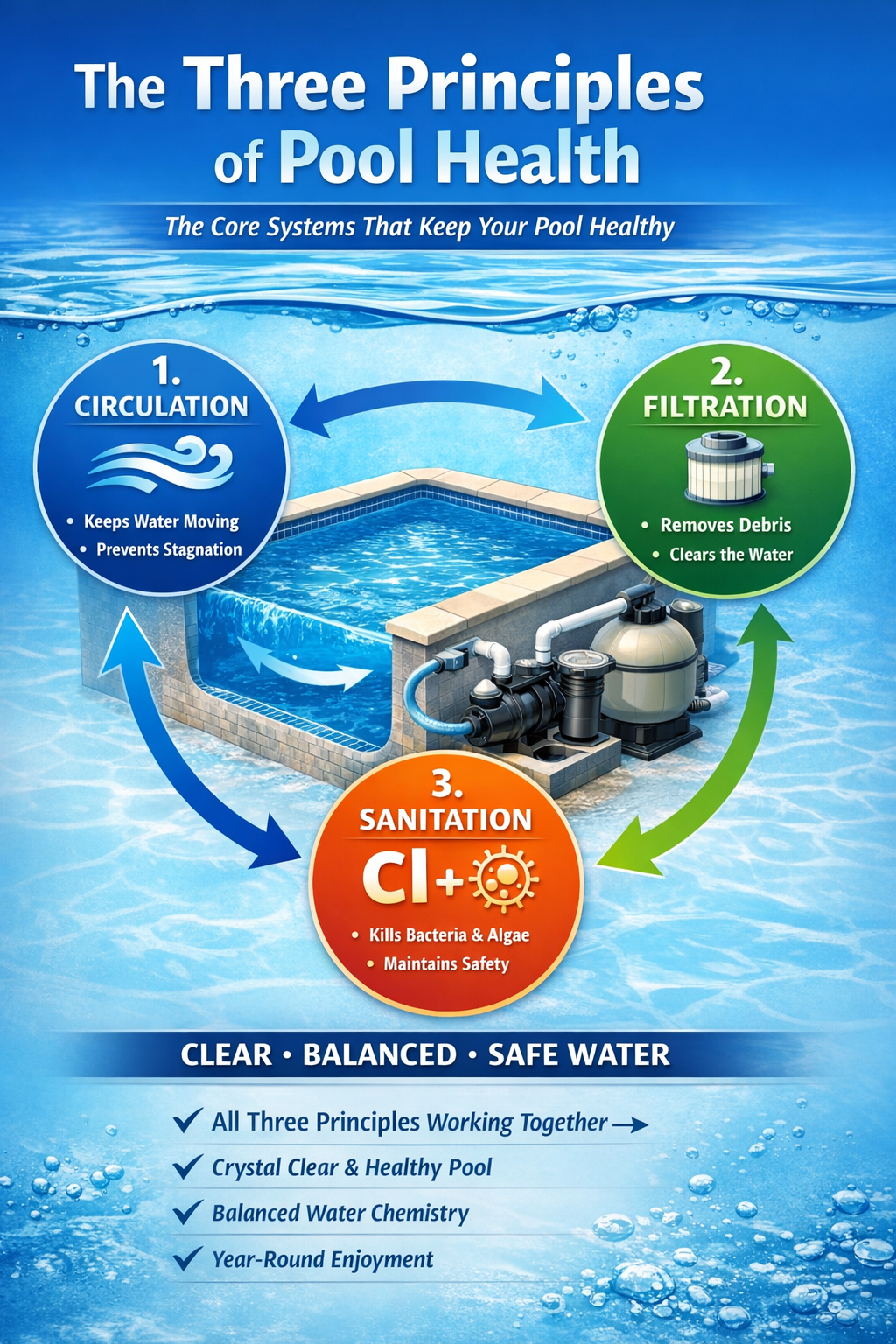
A healthy swimming pool always depends on the balance of three interconnected systems.
Circulation
• Keeps water moving to prevent stagnation
• Distributes chemicals evenly
• Captures airborne contaminants
• Supports filtration and sanitation
Filtration
• Removes suspended debris and particles
• Maintains water clarity
• Protects equipment from buildup
• Reduces long-term water replacement needs
Sanitation
• Destroys bacteria, algae, and microorganisms
• Keeps water safe for swimmers
• Protects surfaces and plumbing
• Maintains proper chemical balance
When circulation, filtration, and sanitation operate together, the result is what every pool owner wants:
Clear, balanced, sustainable water that is safe to enjoy year-round.
Principles That Keep Every Pool Healthy
No two pools are exactly the same.
Every pool develops its own “personality” based on its environment, equipment, and how it is used. Factors such as trees, wind, sunlight, temperature, and swimmer activity all influence how a pool behaves.
However, despite these differences, every swimming pool operates on the same three fundamental principles:
Circulation
Filtration
Sanitation
When these three systems work together properly, the result is clear, safe, balanced water.
If any one of these principles becomes restricted or fails to perform correctly, the pool will begin to decline — often resulting in cloudy water, algae growth, scaling, or equipment strain.
Understanding these fundamentals helps explain how professional pool service protects your pool and keeps the water healthy year-round.
1. Circulation
Keeping the Water Moving
Water that sits still naturally begins to stagnate. Without circulation, debris, dust, pollen, and microorganisms begin to accumulate.
In fact, many airborne particles settle into pools during the early morning hours when temperatures drop and wind slows. Your pool naturally collects what the air carries.
Proper circulation keeps water moving so contaminants can be removed through filtration and sanitation.
Healthy pools should circulate the entire volume of water at least twice per day.
This movement helps:
• prevent stagnation
• distribute sanitizer evenly
• move debris toward the skimmer and filter
• maintain clear and balanced water
Over time, some dissolved materials cannot be filtered or oxidized. These accumulate in the water and contribute to Total Dissolved Solids (TDS).
TDS includes:
• minerals from source water
• chemical byproducts
• dissolved contaminants
• salts and stabilizers used in water chemistry
As water ages, TDS slowly increases and can affect overall water balance and chemical efficiency.
Circulation Guidelines
Single-Speed Pumps
Winter circulation should run a minimum of about 4 hours overnight (2 AM – 6 AM).
This helps protect plumbing from freezing and captures overnight debris in the skimmer.
During warmer months, circulation increases with temperature.
Rule of Thumb:
1 hour of pump runtime for every 10°F of daily temperature
Examples:
• 80°F day → ~8 hours
• 90°F day → ~9 hours
• 100°F day → ~10 hours
Typical summer run times occur between:
• 6 AM – 2 PM
• 6 AM – 4 PM
These schedules help maintain clarity while protecting sanitizer levels.
Variable-Speed Pumps
Modern variable-speed pumps circulate water more slowly but for longer periods.
Typical operation:
12 – 18 hours per day
Benefits include:
• improved filtration efficiency
• more stable water chemistry
• significantly lower energy use
Most variable-speed systems operate for roughly about $1 per day in electricity, while providing excellent circulation.
2. Filtration
Removing Debris from the Water
Circulation moves the water.
Filtration cleans it.
As the pump circulates water, debris and particles are carried into the filter, where they are physically removed.
For filtration to work properly, water flow must remain unobstructed.
Regularly emptying the following helps maintain strong circulation:
• skimmer baskets
• pump baskets
• cleaner wall-fitting screens
Inside the filter, specialized media strain particles from the water.
Common filter types include:
• Cartridge filters
• Diatomaceous Earth (D.E.) filters
• Sand filters
• Glass or zeolite media filters
Proper filter sizing also plays a major role in water clarity. Larger filters allow water to move more efficiently and require less frequent cleaning.
Typical residential filter sizes:
• 300 sq ft – smaller pools
• 420 sq ft – medium pools
• 520+ sq ft – larger pools
These systems generally support pools between 15,000 – 40,000+ gallons.
Filter Maintenance
Filters should be cleaned according to manufacturer recommendations.
Most pools benefit from professional cleaning:
• at the beginning of the swim season
• at the end of the swim season
Proper filter maintenance helps ensure:
• strong water circulation
• clear water
• efficient equipment operation
• longer system lifespan
It also helps reduce the need for expensive partial water replacements.
3. Sanitation
Keeping Water Safe
Sanitation is the final essential principle of pool care.
While circulation moves the water and filtration removes debris, sanitation destroys bacteria, algae, and microorganisms.
Swimming pools achieve this using chlorine, which is derived from salt chemistry.
When chlorine is added to water, it forms hypochlorous acid, the active sanitizer responsible for disinfecting pool water.
For sanitation to work effectively:
• circulation distributes the sanitizer
• filtration removes debris that consumes chlorine
Together these systems function much like the human body:
• Pump → heart (moves water)
• Filter → kidneys (removes impurities)
• Sanitizer → immune system (kills harmful organisms)
When sanitation levels remain balanced and consistent, the pool stays:
• safe for swimmers
• clear and inviting
• protective of surfaces and equipment
Proper sanitation also helps maintain the water saturation balance, preventing conditions that could damage pool surfaces or equipment.
Quick Summary
The Three Essentials of a Healthy Pool
Circulation
• Keeps water moving
• Prevents stagnation
• Distributes sanitizer
• Captures debris
Filtration
• Removes particles and debris
• Maintains water clarity
• Protects equipment
• Supports long-term water quality
Sanitation
• Kills bacteria and algae
• Keeps water safe for swimmers
• Protects pool surfaces and equipment
• Maintains balanced chemistry
✅ When circulation, filtration, and sanitation work together, your pool remains clear, balanced, and safe to enjoy year-round.