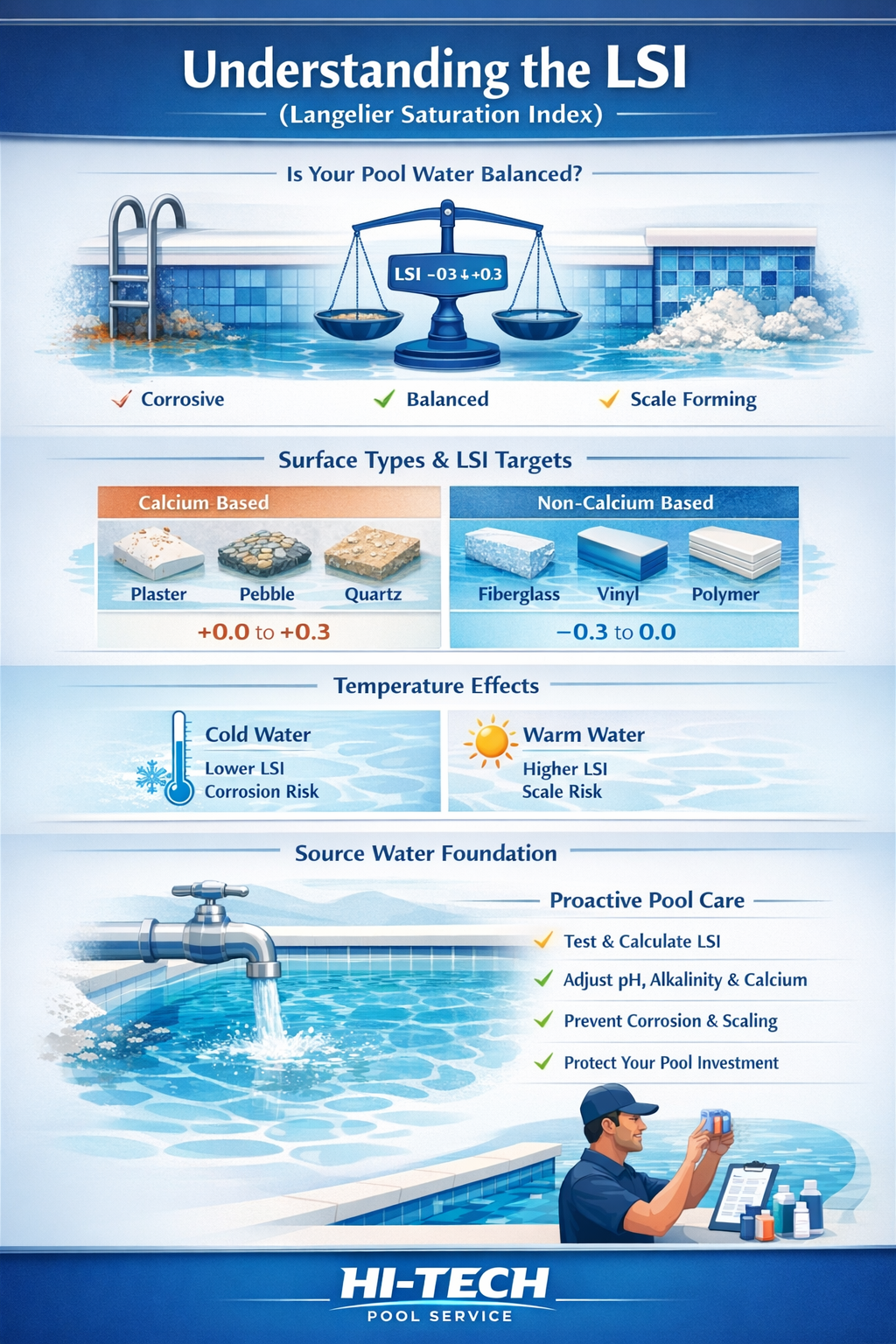
What is the LSI?
The LSI — Langelier Saturation Index — is a calculation used to determine whether pool water is:
• Balanced
• Corrosive (aggressive)
• Scale forming
It predicts how water will interact with calcium-based materials and pool equipment.
In simple terms:
Water is always trying to reach equilibrium with calcium.
If water needs calcium, it will pull it from surfaces (etching / corrosion).
If water has too much calcium, it will deposit it as scale.
The LSI helps determine which direction the water will move.
Typical target range:
LSI ValueMeaningResult-0.3 to +0.3 Balanced Ideal condition Below -0.3 Aggressive Surface etching / equipment wear Above +0.3Scale forming Calcium scale buildup
A professional pool service constantly manages water, so it stays within the balanced zone.
How Surface Type Changes LSI Targets
Different pool surfaces react differently to water chemistry.
Plaster Pools
Plaster is calcium based, meaning water can dissolve it.
Ideal LSI:
0.0 to +0.2
Slightly positive water protects plaster from dissolving.
Risk if too negative:
Surface etching
Rough texture
Premature plaster wear
Pebble Pools
Pebble finishes contain cement matrix and exposed aggregate.
Ideal LSI:
0.0 to +0.3
Pebble is durable, but aggressive water can still dissolve the cement binder.
Quartz Pools
Quartz finishes contain crushed quartz embedded in plaster.
Ideal LSI:
0.0 to +0.2
Quartz is harder than plaster but still contains calcium cement that needs protection.
Fiberglass Pools
Fiberglass is non-calcium based.
Ideal LSI:
-0.3 to 0.0
These pools do not dissolve like plaster, but high LSI can cause:
• calcium scale
• cloudy water
• rough shell deposits
Vinyl Pools
Vinyl liners contain no calcium material.
Ideal LSI:
-0.3 to 0.0
Main risk is scaling on:
• heaters
• salt cells
• plumbing
Polymer Pools
Polymer or composite pools behave similar to fiberglass.
Ideal LSI:
-0.2 to 0.0
The goal is preventing scale while protecting equipment.
How Temperature Changes LSI Seasonally
Temperature is a major factor in the LSI calculation.
Cold Water (Winter)
Cold water lowers the LSI, making water more aggressive.
Common winter issues:
• plaster etching
• metal corrosion
• surface dulling
Service professionals compensate by adjusting:
alkalinity
calcium
pH
Warm Water (Summer)
Warm water raises the LSI, increasing scale risk.
Common summer issues:
• calcium scale
• cloudy water
• salt cell buildup
• heater damage
Proper chemistry adjustments keep water balanced as temperatures rise.
How Source Water Sets the Foundation
Every pool starts with the chemistry of the local fill water.
Source water determines:
• Calcium hardness
• Alkalinity
• pH
• TDS (Total Dissolved Solids)
In regions like Sacramento, source water often already contains moderate to high calcium levels, which means:
pools begin closer to scale forming conditions
evaporation continually concentrates minerals
This makes proper LSI management even more important.
Think of source water as the foundation of the pool's chemistry.
Everything else is built from that starting point.
Why Pool Service Professionals Manage the LSI
A pool is a constantly changing environment.
Daily influences include:
• temperature swings
• evaporation
• rain dilution
• debris and organic load
• sanitizer demand
• refill water chemistry
Because of these changes, LSI constantly shifts.
A trained pool professional acts as an active defense system by:
✔ testing water chemistry
✔ calculating the LSI
✔ adjusting pH, alkalinity, and calcium
✔ preventing scale or corrosion before damage occurs
Proper LSI management protects:
• pool surfaces
• heaters
• pumps
• salt systems
• plumbing
Most importantly, it protects the long-term investment of the pool.
Summary (Key Points)
LSI = The balance point of water and calcium
• Determines whether water is corrosive, balanced, or scale forming
• Target range is generally -0.3 to +0.3
Surface type matters
Plaster / Pebble / Quartz → Slightly positive LSI preferred
Fiberglass / Vinyl / Polymer → Slightly neutral to negative
Temperature shifts LSI
Cold water → more aggressive
Warm water → more scale forming
Source water sets the starting chemistry
Local water mineral levels determine the baseline LSI.
Professional service protects the pool
Technicians actively adjust chemistry to keep the LSI balanced and prevent damage.